Statement on Supplementary Financial Memorandum
Following amendments made at Stage 2 of the Children (Care, Care Experience and Services Planning) (Scotland) Bill, the Scottish Government published a supplementary Financial Memorandum setting out the potential financial implications of those changes.
The purpose of a Financial Memorandum
Financial Memorandums are a required part of the Scottish Parliament’s legislative process. Their purpose is to provide an estimate of the potential costs associated with implementing a Bill so that the Scottish Parliament can scrutinise the financial implications of legislative change.
They are an important tool for parliamentary scrutiny. They are estimates based on currently available data, rather than precise forecasts.
They are prepared at a point when the detailed design of policy implementation, operational models and workforce arrangements is often still developing. As a result, they necessarily rely on assumptions and modelling and are only able to use the data that is currently available. Some of these assumptions are made at the upper end of expectations and are therefore deigned to be a ‘maximum cost’ scenario. Others will argue that some of the assumptions underestimate the true cost of implementation.
In the case of Scotland’s ‘care system’, available data on costs, outcomes and demand is often incomplete or inconsistent, which limits the level of precision that can be achieved.
Financial memorandums need to work with the information available at a point in time, which is often ‘lag’ data and not reflective of the significant changes already underway in the system.
Financial Memorandums also focus primarily on the direct financial costs to public authorities. They do not quantify the wider social or economic impacts of legislative change, including:
- long-term outcomes for children, young people, families, or care experienced adults
- avoided costs associated with improved services
- the wider social and financial impacts of legislative change
Importantly, they do not quantify the human costs of how systems operate and how the support provided to children and families affects their lives over time.
What this Financial Memorandum reflects
The supplementary Financial Memorandum accompanying this Bill reflects the direct financial costs to public authorities of the amendments made at Stage 2, including provisions relating to continuing care, support for kinship carers and access to advocacy, amongst others.
Further information about the provisions and the parliamentary debates in which they were discussed is available in on the Scottish Parliament website.
Financial memorandums very regularly exist in contested territory. For example, in 2022, The Finance and Public Administration Committee carried out post legislative scrutiny of the Financial Memorandum for the Children and Young People (Scottland) Bill (which became the 2014 Act). The Committee recognises the inherent uncertainties involved in the development of financial memorandums and the fact that there is often disagreement between Scottish Government and those responsible for implementation. These issues are not new.
Financial memorandums also struggle to capture the wider effects of long-term systems change. As the promise is kept, there will be fewer children and families experiencing the care system. Wider public service reform activity, particularly around tackling child poverty and embedding whole family support, will be key to moving support ‘upstream’ and ensuring more children, families and care experienced adults are able to thrive and not rely on intensive support.
The wider financial context
In any conversation about costs, questions are, rightly, raised about the affordability and implementation of the changes required. They too are an important part of legislative scrutiny.
In this case, they reflect broader challenges currently facing local government and public services, including workforce pressures and constrained budgets. These challenges are real and should be considered carefully. They are also not unique to this legislation.
The additional investment required to implement this Bill effectively should be considered in the context of overall spend on care and care experience in Scotland, and the extent to which current spend is delivering value for money.
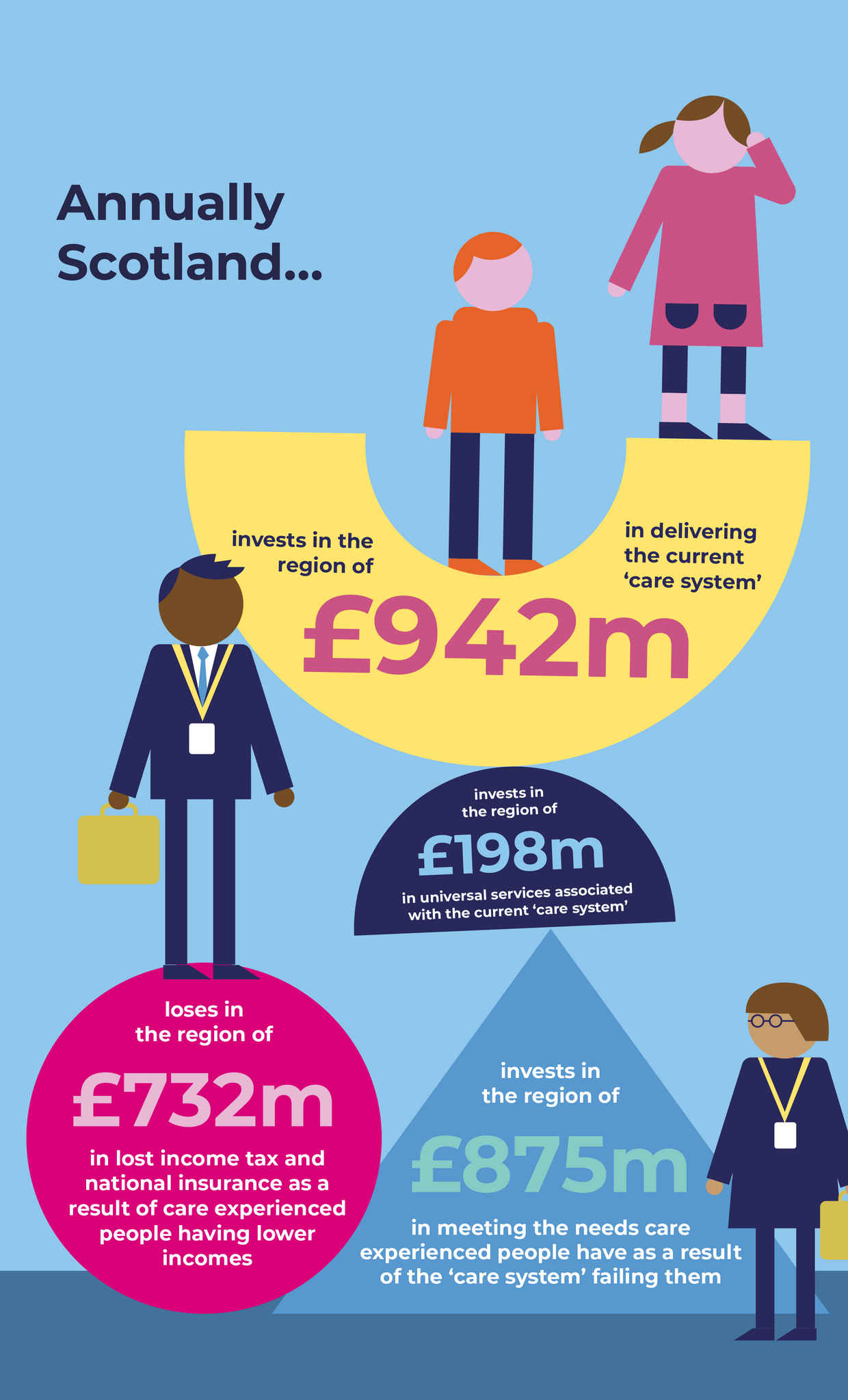
The Independent Care Review examined the financial context of Scotland’s care system and concluded that the current system already involves substantial public expenditure. The Follow the Money report published in 2020 estimated that delivering the then ‘care system’ costs:
- approximately £942 million in direct system costs annually
- £198 million estimated in universal services used by care experienced people
- a further £845 million estimated to be associated with addressing the consequences of the poor outcomes experience of care creates.
In October 2025, The Auditor General for Scotland and the Accounts Commission published their report, ‘Improving care experience: Delivering The Promise’. It found that in 2023/24 local authorities alone spent £1.2 billion on ‘services related to care experience’. The additional investment required to deliver the legislation, over the medium to long terms, should be considered in that context.
The Independent Care Review was clear: improving outcomes for children and families requires different patterns of investment and earlier support, rather than continuing patterns of spending that often lead to higher costs later.
In any case, the real costs of care are borne by the people who experience it, not the system and it is to them the Scottish Parliament is accountable for the promise it made in February 2020.
Implementation
The Financial Memorandum for The Children (Care, Care Experience and Services Planning) (Scotland) Bill is therefore an important input to parliamentary scrutiny, but only one part of the information available to MSPs when considering legislation.
Plan 24-30 and The Promise Story of Progress means that Scotland is clearer than it has ever been on what needs to be done, by whom and by when. It will be updated on an ongoing basis.
Effective implementation of the provisions within the Bill will require:
- clear sequencing of new and existing duties
- alignment with other legislative and policy reforms
- transparent identification of funding
- workforce planning and capacity development
- communication with children, families and the care community about how changes will be implemented.
These considerations are essential to ensuring that legislative change translates into improved outcomes in practice.
Stage 3 Blog
Read more about implementation and what is included in the Bill in our Stage 3 blog.